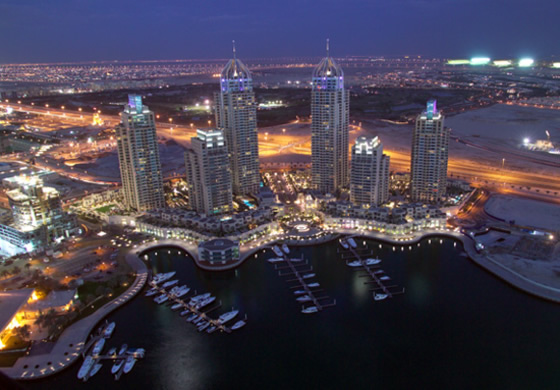
Abu Dhabi is the largest of the seven emirates that comprise the United Arab Emirates and was also the largest of the former Trucial States. Abu Dhabi is also a city of the same name within the Emirate that is the capital of the country, in north central UAE.
An Investors guide to Abu Dhabi
The capital of fine living. Abu Dhabi the capital of United Arab Emirates. Ranked as the No.1 city in the Arab world in the annual survey by the Economist Group, Abu Dhabi has built a niche reputation for itself as a modern yet enchanting destination for both business and leisure. The city has a unique mix of abundant natural beauty, traditional Arabian charm and cosmopolitan sophistication. Its exotic coastline stretches over 200 islands, gently kissed by the azure waters of the Arabian Gulf. Combined with its beautiful beaches, myriad of water sports from sailing to diving and deep-sea fishing, top international resorts, designer shopping outlets and thriving business environment, Abu Dhabi is truly the capital of life.
AL REEM ISLAND
300 meters away from Abu Dhabi Island. 11 bridges are planned to connect REEM ISLAND to ABU DHABI city and surrounding Islands. REEM ISLAND is a 6.3 Sq Km divided in to 3 Master developments (20% SHAMS by SOROUH) , (20% NAJMAT by REEM DEVELOPERS) and 60% TAMOUH.
MASTER DEVELOPMENT
Najmat.The Star of Abu Dhabi.
Occupying prime seafront on Al Reem Island and just 300 meters away from the Abu Dhabi City Centre, Najmat Abu Dhabi is an extraordinary development with business/residential towers, shopping centers, restaurants, cafes and fantastic views of the Abu Dhabi City and Arabian Gulf. Aesthetically master planned by renowned international architects, town planners and designers, this community offers a unique level of balance and harmony.
City Centre just 300 meters away from Najmat Abu Dhabi 20 minutes from Abu Dhabi International Airport Provides a convenient shortcut to Dubai Environment conscious planning with open parkland, playgrounds & bike
More about Abu Dhabi
The city lies on a T-shaped island jutting into the Persian Gulf from the central western coast. An estimated 1,000,000 people lived there in 2000, with about an 80% expatriate population. The Emirate has approximately 70% of the country's entire wealth. Al Ain is Abu Dhabi's second largest urban area with a population of 348,000 (2003 census estimate) and is located 150 kilometers inland.
Parts of Abu Dhabi were settled as far back as the 3rd millennium BC and its early history fits the nomadic, herding and fishing pattern typical of the broader region. Modern Abu Dhabi traces its origins to the rise of an important tribal confederation the Bani Yas in the late 18th century, who also assumed control of Dubai. In the 19th century the Dubai and Abu Dhabi branches parted ways.
Into the mid-20th century, the economy of Abu Dhabi continued to be sustained mainly by camel herding, production of dates and vegetables at the inland oasies of Al Ain and Liwa, and fishing and pearl diving off the coast of Abu Dhabi city, which was occupied mainly during the summer months. Most dwellings in Abu Dhabi City were, at this time constructed of palm fronds (barasti), with the better-off families occupying mud huts. The growth of the cultured pearl industry in the first half of the 20th century created hardship for residents of Abu Dhabi as pearls represented the largest export and main source of cash earnings.
In 1939, Sheikh Shakhbut Bin-Sultan Al Nahyan granted Petroleum concessions, and oil was first found in 1958. At first, oil money had a marginal impact. A few lowrise concete buildings were erected, and the first paved road was completed in 1961, but Sheikh Shakbut, uncertain whether the new oil royalties would last, took a cautious approach, preferring to save the revenue rather than investing it in development. His brother, Zayed bin Sultan Al Nahayan, saw that oil wealth had the potential to transform Abu Dhabi. The ruling Al Nahayan family decided that Sheikh Zayed should replace his brother as Ruler and carry out his vision of developing the country. On August 6, 1966, with the assistance of the British, Sheikh Zayed became the new ruler.
With the announcement by Britain in 1968 that it would withdraw from the Gulf area by 1971, Sheikh Zayed became the main driving force behind the formation of the United Arab Emirates.
After the Emirates gained independence in 1971, oil wealth continued to flow to the area and traditional mud-brick huts were rapidly replaced with banks, boutiques and modern highrises.
Abu Dhabi Property Investment Outlook
Although Dubai beat it to the punch in relation to the sale of property to foreign investors, Abu Dhabi is showing signs that it may well eventually dethrone Dubai in terms of ‘‘whatever money can buy’’ architecture.
>> MORE from CNN Money
Why Us
Just a few reasons
Investment Matching Service
Supply your budget and timescale and let us do the rest. We will supply a selection of options to choose from.
We are directly contracted to the developers we represent - no lengthy complicated chains
All payments and legal contracts are handled directly by the developer - we take no monies
We will place buyers in contact with the correct personnel at the developers offices
We offer after sales services
We provide currency conversion at excellent rates through leading known companies