Australia is a large and geographically diverse property market rather than a single residential market. For an international buyer researching property from outside Australasia, the distinction matters. Sydney, Melbourne, Brisbane, Perth, Adelaide and Canberra have very different urban structures, while coastal Queensland, regional New South Wales, Tasmania and Western Australia introduce quite different lifestyle, tourism and investment characteristics.
The scale of the country also changes the way property should be researched. A search for Australian property can encompass metropolitan apartments, suburban houses, coastal homes, rural and lifestyle properties, development opportunities and investment-oriented residential property. The right market therefore depends as much on location and intended use as on the property itself.
Australia's position within the wider Asia-Pacific region also gives it a distinctive international property profile. It is closely connected to major Asian economies while offering a mature legal, financial and infrastructure environment. For overseas buyers, however, the market has a specific regulatory framework for foreign investment, making the distinction between researching property and being legally able to acquire a particular property important.
Understanding the Australian Property Market
Australia's residential property market is structured around a relatively small number of major metropolitan centres together with extensive regional and coastal markets. The capital cities act as major employment, education, business and infrastructure hubs, while regional markets can be driven by tourism, lifestyle migration, agriculture, resources, retirement and local employment.
This creates substantial variation in property demand. Inner-city apartments may serve investors, professionals and students, while established suburban houses are often associated with family occupation. Coastal markets can combine permanent residential demand with tourism and lifestyle demand, whereas resource-oriented regions may respond more strongly to employment and infrastructure cycles.
Recent national data illustrates why Australia should not be treated as one uniform market. The Australian Bureau of Statistics reported approximately 11.5 million residential dwellings nationally in the March quarter of 2026, with significant differences in dwelling values between states and territories. By the June quarter, the national value of residential dwelling stock had softened, while individual state markets continued to move in different directions. :contentReference[oaicite:0]{index=0}
For an international researcher, these differences are more useful than a single national price figure. The first question should normally be where in Australia the property is located and what economic, lifestyle or investment characteristics support that location.
Sydney, Melbourne and Australia's Major Cities
Sydney is Australia's largest and most internationally recognised property market. Its appeal extends across the central business district, established eastern and northern suburbs, western Sydney and a long coastal corridor. Property ranges from high-rise apartments and city residences to detached suburban houses and premium waterfront property.
Melbourne has a different urban character, with a strong central apartment market surrounded by extensive established suburbs. Its property landscape includes city apartments, traditional suburban housing, premium inner-city locations and expanding outer metropolitan areas. The city also has a significant international population and major education sector, which contribute to its connection with overseas markets.
Brisbane provides another important point of comparison. Its metropolitan area combines established inner suburbs with rapidly developing outer areas and is closely connected to the wider Queensland property market. Queensland also contains some of Australia's most internationally recognised coastal destinations, creating a much broader property landscape than the Brisbane metropolitan market alone.
Perth and Adelaide provide further contrasts. Perth is geographically separated from Australia's eastern capitals and has a strong relationship with Western Australia's resources economy, while Adelaide has a more compact metropolitan structure and a diverse economy. Canberra, as the national capital, has a property market shaped partly by government, professional services and institutional employment.
Coastal and Lifestyle Property in Australia
Australia's coastline creates one of the country's most important property distinctions. Coastal property is found close to major cities as well as in smaller tourism and lifestyle destinations, and the underlying reasons for demand can vary considerably between them.
Queensland is particularly diverse, extending from the Gold Coast and Sunshine Coast to tropical North Queensland. The Gold Coast combines a major urban population with tourism, high-rise apartments, resort accommodation and established residential neighbourhoods. The Sunshine Coast has a different mix of coastal towns, suburban development, lifestyle housing and tourism-related property.
Further north, Cairns and other tropical destinations introduce a stronger relationship between property, tourism and the natural environment. Coastal markets elsewhere in New South Wales, Victoria, South Australia, Western Australia and Tasmania similarly range from commuter-oriented locations to holiday and retirement destinations.
International buyers considering lifestyle property should therefore look beyond proximity to the coast. Accessibility, permanent population, local employment, tourism patterns, infrastructure, services and the intended use of the property all influence how a coastal market functions.
Australian Property Types
Australian residential property encompasses several distinct asset classes. Detached houses remain an important part of suburban and regional markets, particularly where land availability allows lower-density development. Apartments are more concentrated in central areas, established inner suburbs and high-density coastal locations.
Townhouses and other medium-density housing occupy an important position between apartments and detached houses. They are particularly relevant in expanding metropolitan areas where planning policies and land costs encourage greater residential density.
At the premium end of the market, Australia also has substantial luxury property, including waterfront residences, architect-designed homes, large coastal estates and prestigious city properties. These markets can behave differently from mainstream residential housing because location scarcity, land quality, views, privacy and architectural characteristics become particularly important.
For buyers looking beyond conventional residential property, Australia's large geographic area also provides rural, agricultural and lifestyle opportunities. These should be treated as separate property categories because ownership structures, land use, access, services and legal considerations can differ significantly from ordinary residential purchases.
Buying Australian Property From Overseas
International buyers need to distinguish between the Australian property market and Australia's foreign investment rules. Australia has a formal regulatory framework governing foreign investment, and residential real estate is subject to specific requirements administered through the Australian Taxation Office and the broader foreign investment system. The applicable rules depend on factors including the buyer's status, the type of property and the proposed use.
The framework is designed in part around directing foreign investment towards additional housing supply. Government guidance distinguishes between new dwellings, vacant residential land and established dwellings, and the rules applying to these categories can change over time. Foreign investors should therefore check the current requirements before entering into a purchase. :contentReference[oaicite:1]{index=1}
This makes professional due diligence particularly important for an overseas buyer. Eligibility, approval requirements, ownership structure, taxation, development conditions and reporting obligations should be established before committing to a transaction rather than treated as matters to resolve after finding a property.
The Australian framework also includes requirements relating to the Register of Foreign Ownership of Australian Assets for certain foreign ownership transactions. These obligations are separate from simply finding and purchasing a property and form part of the wider compliance process for international buyers. :contentReference[oaicite:2]{index=2}
Property Investment and Market Selection
Property investment in Australia cannot be reduced to selecting the location with the highest recent price growth. A more useful assessment considers the relationship between employment, population, infrastructure, housing supply, transport, education, tourism and the type of property being purchased.
Major metropolitan markets can offer depth and a broad range of property types, while regional markets may have more specialised demand. A coastal apartment aimed at tourism or lifestyle use is exposed to different influences from a suburban house intended for long-term occupation. Similarly, a development site should be assessed through planning, land use, construction and local supply considerations rather than through residential sale prices alone.
Recent market conditions also demonstrate the importance of examining individual locations rather than relying on national headlines. ABS data for 2026 showed different movements between states, while market reporting identified different conditions across individual capital cities. Such variation is a normal feature of Australia's geographically dispersed property system. :contentReference[oaicite:3]{index=3}
Australia Within the Asia-Pacific Property Landscape
Australia should also be considered within the wider Asia-Pacific property market. Its cities are separated from the major population centres of East and Southeast Asia by geography, but extensive trade, education, migration, tourism and investment connections create strong regional links.
For an overseas buyer researching several countries, Australia can therefore be compared with New Zealand and Pacific destinations as well as with Asian markets. New Zealand offers another mature English-speaking property market with its own geographic and regulatory characteristics, while Fiji and Vanuatu provide very different island and tourism-oriented property environments.
These differences make geographical comparison useful. An international buyer considering an Australian coastal property may also be researching New Zealand lifestyle property or Pacific resort markets, but the ownership structures, market scale, infrastructure and investment environment are not interchangeable.
For broader regional research, see New Zealand Property, Fiji Property and Vanuatu Property.
Researching Property for Sale in Australia
The Australian property market is sufficiently diverse that an international search should begin with location, property type and intended purpose rather than individual listings. Once the appropriate market has been identified, buyers can compare available properties within that geographical and property context.
The Australia property listings section provides a starting point for researching available property. Listings should be treated as part of the research process rather than as a substitute for independent verification of ownership, condition, title, planning matters, costs or the legal ability of an overseas buyer to complete the proposed transaction.
For international buyers, the strongest research process is therefore layered: understand Australia geographically, identify the appropriate city, region or coastal market, determine the relevant property type, examine the local market structure and then investigate individual properties. This approach provides a clearer picture of how a particular property fits within the much larger Australian property market.
Australasia offers a diverse mix of mature and emerging property markets, ranging from global cities in Australia and New Zealand to tourism-driven and lifestyle destinations across the South Pacific. This guide highlights investment trends, popular locations, and property types attracting international buyers and investors.
Why Invest, Buy or Rent in Australasia
- Stable legal frameworks in established markets.
- Strong lifestyle and tourism-driven rental demand.
- Wide range of FSBO and agent-assisted listings.
- Opportunities across residential, resort, and land investments.
- Access to regional market insights to guide overseas buyers.
Key Considerations for International Buyers
Before investing, consider:
- Foreign ownership rules and residency-linked restrictions.
- Market pricing, rental demand, and long-term growth potential.
- Short-term rental regulations in resort destinations.
- Currency exposure and international finance options.
- Local property management and resale liquidity.
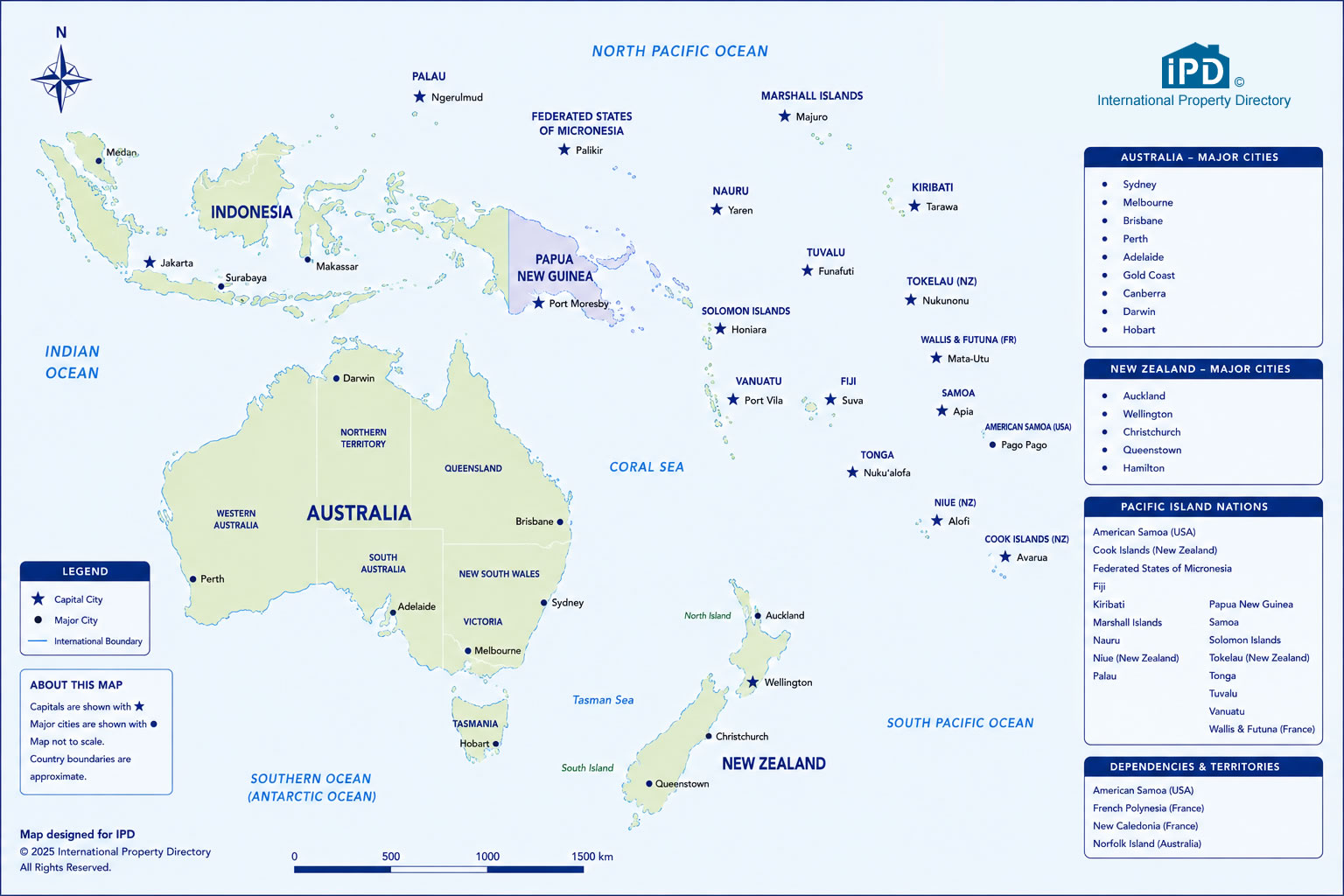
Click the map to open a fullscreen version in a new window, allowing you to zoom in.
 Australia Property – Coastal villas, city apartments, and high-yield residential and lifestyle investments.
(View Listings)  New Zealand Property – Lifestyle estates, coastal homes, and urban investment opportunities.
(View Listings)  Fiji Property – Resort developments and beachfront villas with strong tourism appeal.
(View Listings)  Vanuatu Property – Citizenship-linked real estate and tourism-focused investment homes.
(View Listings) |
Australasia Property Guides
- How to Buy Property in Australasia
- How to Rent Property in Australasia
- How to Sell Property in Australasia
- Australasia Property Investment Insights
- Australasia Property Market Data
Australasian Property by Region
Explore property markets across Australasia. Select a country or territory to view listings, market insights, and FSBO or agent-assisted opportunities.
Australia
AustraliaCoastal villas, city apartments, and high-yield residential investments.
Christmas Island
Eco-focused developments and secluded island retreats.
Cocos (Keeling) Islands
Private island lifestyle and low-density investment opportunities.
Norfolk Island
Tourism-driven residential and resort property markets.
Zealandia & Polynesia
Cook IslandsIsland villas and tourism-linked estate investments.
Niue
Low-density residential and long-term lifestyle investments.
Tokelau
Small-island holiday homes and niche property markets.
Fiji
Luxury resorts, coastal villas, and tourism-driven properties.
Melanesia & Nearby Islands
New CaledoniaCoastal resorts and lifestyle estates.
Papua New Guinea
Residential housing and land investment opportunities.
Solomon Islands
Eco-developments and private island retreats.
Vanuatu
Tourism-focused homes and investment estates.
|